
Why Data is Philanthropy’s Next Equity Frontier
From extraction to empowerment.
By Rebecca Bailey, Impact Partner, Exponent Partners
As AI seemingly proliferates every industry, the philanthropic sector is facing a critical paradox. While the principles of Trust-Based Philanthropy have started to gain significant traction, the sector is continuing to operate on legacy extractive data frameworks.
Left unaddressed, AI adoption will only exacerbate this core issue. Simply put, data is philanthropy’s next equity frontier.
In a sense, data can be viewed as a physical manifestation of a foundation’s power dynamics. It represents the tangible impact that grantees generate to advance a shared mission. Without data, philanthropy would have no way of understanding whether its investments are producing change.
In a sense, data can be viewed as a physical manifestation of a foundation’s power dynamics.
But data typically only flows one way — from the communities, to the nonprofits, to the funders. This may not be by design; it often occurs by default, as a by-product of the complex technology systems where collected data resides.
There is a growing movement to ensure a reciprocal data relationship, but it is only just emerging. This article outlines the structural shifts required to begin truly building reciprocal data relationships.
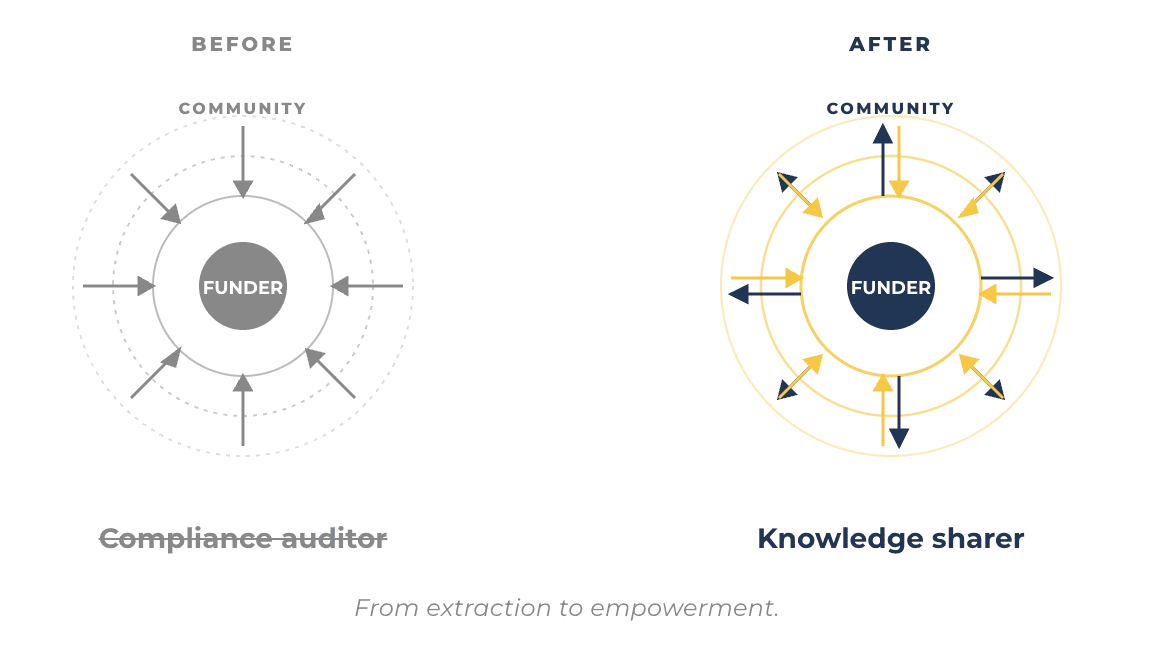
To genuinely shift power, foundations must align their infrastructure with their values, transitioning from data extraction to data empowerment by fundamentally rewiring how impact is collected, stored, and shared.
To do this, foundations must confront an uncomfortable truth: most grantmakers do not actually control the systems they use.
Who Truly Owns Your Data?
Even though a funder may legally own its data, if that data is locked inside a proprietary Grant Management System (GMS) or commercial CRM, it is operationally equivalent to renting space from the vendor. While legally belonging to the foundation, vendors have significant control over how data can be accessed, moved, and managed.
This creates several issues. At the surface level, the foundation becomes trapped in its vendor’s worldview — sometimes a worldview diametrically opposed to its own. Vendors have a strong commercial incentive to keep customers confined within their “walled gardens.”
This plays out in the immediate strategic pain of forcing complex philanthropic work into rigid, pre-built commercial software models. Operating within the constraints of a vendor’s structure directly dictates how a foundation can view and analyze the impact of its investments.
The Ethical Liability of Renting Your Data
But there is a bigger issue at play: protecting the people behind the numbers. What is data, after all?
At its core, data represents the stories, lived experiences, and sensitive information related to the people and communities served by grantees. These are real lives, real stories, and real risk if that information falls into the wrong hands.
Relying on closed, third-party commercial platforms to house sensitive, lived-experience data inadvertently outsources a foundation’s duty of care to a corporate terms-of-service agreement. These agreements change over time, and if they evolve into a fundamental challenge to the foundation’s ethical use policy, it will force the foundation into a corner.
Hidden in the fine print, most vendors have strict export limits that do not provide affordable options to migrate data to another system without losing critical context.
This lack of true ownership is not just an internal vulnerability for the foundation. Because grantmakers are trapped within these rigid, rented systems, they invariably pass the friction downstream to the communities they fund.
How Rigid Systems Extract Power
Recent shifts towards Alternative and Oral Reporting (AOR) have gained significant traction as philanthropy comes to terms with the trickle-down effect of bad reporting mechanisms. When a foundation’s processes — often driven by its technology — are inflexible, the grantee pays the price in administrative labor.
Traditional reporting forces nonprofits to do uncompensated data entry work for their funders, translating their real-world operational data to fit each funder’s bespoke metrics. This severely limits an NGO’s freedom of movement and ability to scale their funding without duplicating administrative labor. AOR has gained rapid traction as both grantmakers and grantees seek to reduce this translation burden.
But reporting mechanisms are just one part of the problem. Funders embracing AOR have quickly found themselves with a sprawl of unstructured, often qualitative data that is difficult to translate into meaningful insights without significant manual labor, even when employing AI to assist.
“The issue comes back to the systems. As long as foundations use a monolithic system to collect, store, manage and analyze their rented data, no meaningful structural change is possible.”
Freeing Your Data
Resolving the rent vs. own challenge requires a paradigm shift. Foundations must consider physically decoupling where their data lives from the software used by staff for daily grants management.
To truly own their data — and uphold their ethical responsibility with this sensitive information — we believe foundations should embrace the strategic imperative of building a centralized, independent data vault.
| Renting Your Data | Owning Your Data |
|---|---|
| Data locked inside a proprietary GMS or commercial CRM | A centralized, independent data vault |
| Vendor controls how data is accessed, moved, and managed | Historical narrative permanently secured |
| Foundation trapped in its vendor’s worldview | Immune to future software vendor changes |
| Heavy lifting falls on the grantee | Heavy lifting shifts to the foundation’s systems |
In technology, this is conceptually known as a data lakehouse — a separate system that houses data and ensures the organization’s historical narrative is permanently secured and fully controlled by the foundation. The foundation becomes immune to future software vendor changes.
This type of architecture finally allows the foundation to shift the heavy lifting from the grantee to the foundation’s independent systems. Once data is centralized, leadership gains a macro-level, systems view of their impact using standard analytics.
Equitable AI and Knowledge Sharing
Shifting to a sovereign data foundation provides immediate value to foundations, with or without AI. But it also lays the groundwork for exploring equitable uses of AI.
Deploying safe, ethical, and localized AI models on fragmented, rented, or vendor-biased systems is incredibly difficult. A clean, sovereign data hub ensures that AI analyzes the foundation’s true localized reality, rather than hallucinating on bad data.
Whether using standard Business Intelligence tools or advanced AI, decoupled data allows foundations to aggregate anonymized grantee metrics alongside massive external datasets — think municipal housing, climate risk, census data.
The ultimate goal in leveraging these capabilities is to transform the funder’s position from a compliance auditor to a knowledge sharer. Building secure infrastructure to pipe systemic insights, gap analyses, and trend lines back to the local NGOs operating on the ground has the potential to truly transform how nonprofits operate.
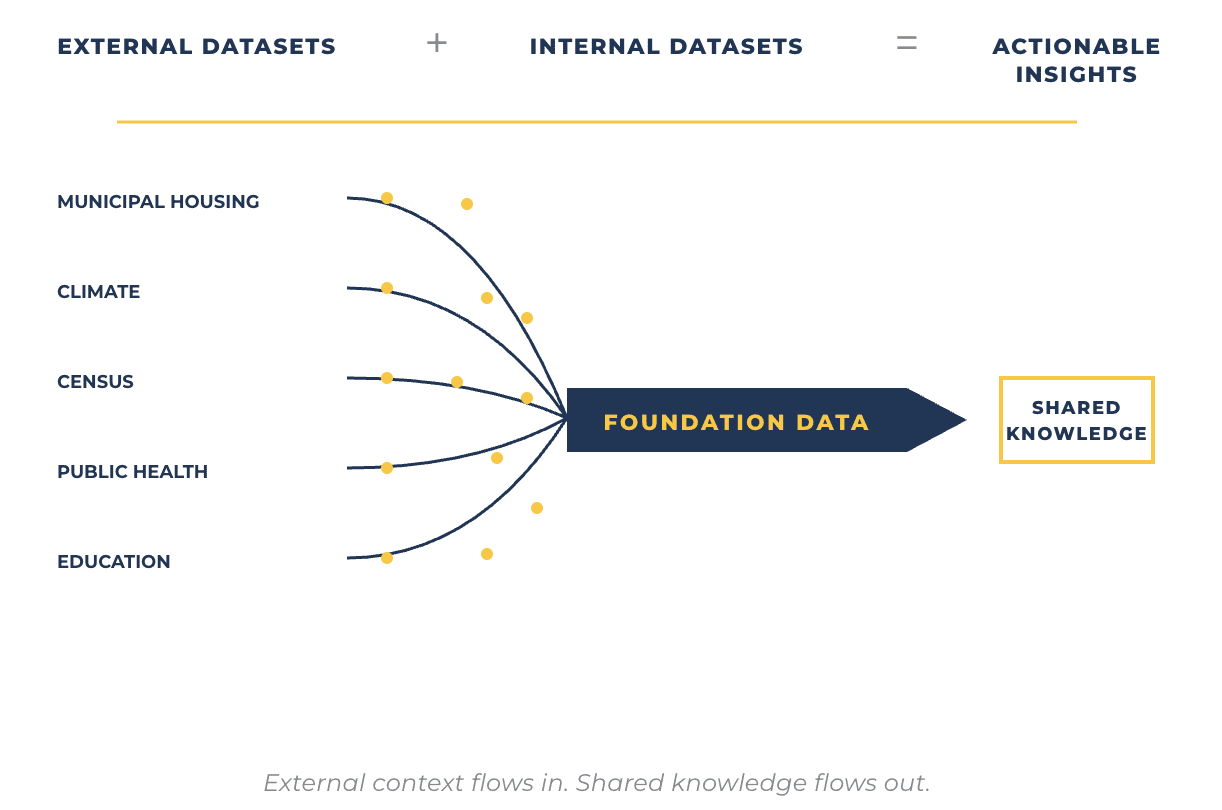
What if the data collected over the last decade could be transformed into meaningful, actionable insights that nonprofits and funders together could rally around?
Architecture as an Act of Trust
At the end of the day, a foundation’s digital infrastructure may be the most literal, daily expression of its values and power dynamics.
“At the end of the day, a foundation’s digital infrastructure may be the most literal, daily expression of its values and power dynamics.”
Moving away from viewing information systems as back-office tools for compliance and oversight — and reimagining them as primary vehicles for equity and community empowerment — is how data can become the new frontier for equitable grantmaking.
Foundations have an opportunity to reimagine their role in the data ecosystem, shifting from hoarding community narratives to responsibly stewarding them. By approaching data with intention, equity and systems change in mind, we believe foundations can evolve from perpetuating data extraction to true data empowerment.
We are planning a series of guided conversations with nonprofit leaders around data readiness and what it actually takes to build a data environment your organization can rely on — one that upholds your values and serves the communities you fund. Request to join the conversation.