Techbridge Logo

TechBridge: First Case Management Implementation Partner

Exponent Partners selected TechBridge as the first official implementation partner of Exponent Case Management (ECM) because we believe the right technology can transform an organization’s relationship to their data. We’re enlisting allies to help spread this message to the entire social sector and TechBridge has agreed to join forces.

Headquartered in Atlanta and serving clients throughout the United States, TechBridge’s mission, values, and dedication to the nonprofit sector align with Exponent Partners. Since 2000, TechBridge has demonstrated success matching the needs of nonprofits to technology.

Shared Values and Purpose

“We can’t imagine a better fit in terms of our values and goals to advance the nonprofit sector,” said Rem Hoffmann, Fonder and CEO at Exponent Partners. “Like TechBridge, the goal of Exponent Partners, and in turn, the goal of our Exponent Case Management app, is to help advance a nonprofit’s maturity model so they can scale up programs and amplify their social impact.”

Similar to Exponent Partners, Techbridge helps enable nonprofits leverage tools like the Salesforce platform to advance programs for the people they serve. TechBridge has expertise in nonprofits and all aspects of technology, with a team of dedicated consultants who continuously monitor the latest innovations, insights, and best practices.

Image description: Staff at TechBridge - an official Exponent Case Management implementation partner - working together to build a home and lift a wall. Source: Techbridge.org
As part of the Salesforce ecosystem, Exponent Case Management is a platform solution that can extend beyond other program-specific applications that aren’t connected to an organization as a whole. Program management point solutions may track outputs, such as number of clients served, but only the Exponent Case Management app was designed to go further, propelling a nonprofit’s impact and performance measurement. In this context, performance measurement is about providing nonprofit leaders with real-time, actionable data to measure program outcomes in a transparent way. The outcomes data are used to validate an organization’s theory of change and gauge mission attainment.

“As an official Exponent Case Management implementation partner, TechBridge recognizes the power of the Salesforce platform for nonprofit program management and outcomes measurement,” said Karen Cramer, Director of Performance Measurement, at TechBridge. “We are thrilled to be the first official implementation partner because Exponent Partners has spent over a decade developing the most robust application for case managers, program directors, and agency leaders.”

Next Generation Case Management

Exponent Case Management is built for the needs of today’s human services agencies. You need to prove results to your funders, access data that tells you how to improve your programs, and reduce manual work for your staff. Our product provides automated workflow and alerts, access on mobile devices, drag and drop reporting, and outcomes measurement. Want to see ECM in action? Register for our next webinar and live demo.

For questions about the app or the Partner Program, contact us today!

Photo: Mother reading to a smiling toddler who is sitting on her lap.

Einstein Analytics: Chicago Benchmarking Collaborative

Chicago Benchmarking Collaborative (CBC) is an alliance of seven education and human service agencies dedicated to increasing the quality of services offered to low-income families in Chicago’s most underserved neighborhoods. Prior to launching the Salesforce platform with Exponent Case Management (ECM) and Einstein Analytics, time-consuming reporting meant infrequent benchmarking and lessened the value of the collaborative.

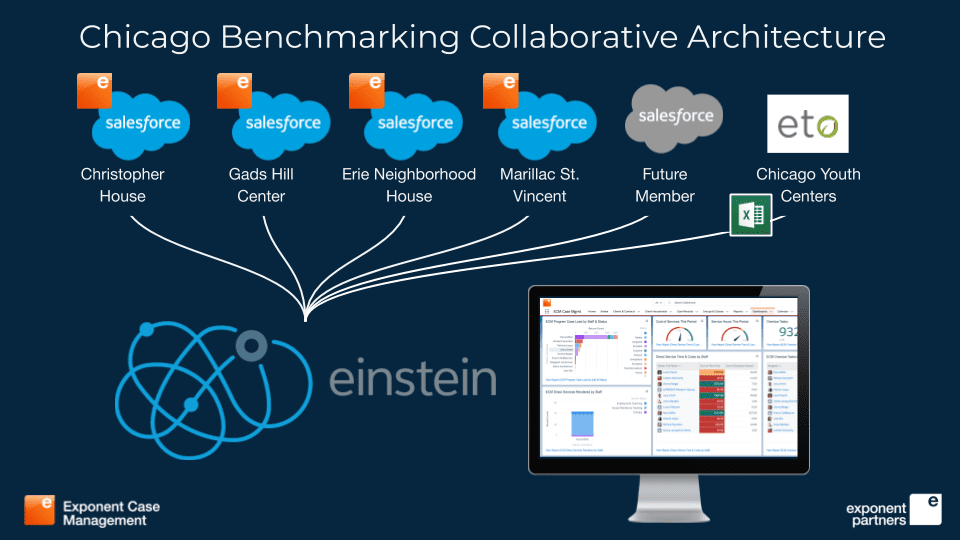
Exponent Partners implemented ECM for four CBC organizations thus far, plus a central benchmarking data warehouse powered by Einstein Analytics. Christopher House serves as both a member of CBC as well the Collaborative’s Project Manager. Now, with Einstein Analytics, Christopher House has a centralized dashboard with real-time data on the entire population being served across the collaborative.

Diagram of Chicago Benchmarking Collaborative Salesforce architecture

Compared to the previous solution, Christopher House has reduced three reports into one report of anonymized, standardized data for benchmarking. In the past, Christopher House used to manually create data visualizations for sharing with the rest of the Collaborative. Now, the responsive Einstein Dashboards help them visualize the data in ways much more meaningful than a number or percentage. This provides the Collaborative with greater transparency and insights. Moving forward, all collaborative members can view and explore benchmark data.

Beyond Tracking Outcomes

One of CBC’s programs tracks teaching strategy, goals, and regular assessments for early childhood development and education. The ultimate goal is to prepare children for kindergarten, by focusing on three key domains: literacy, math, social-emotional, language, physical, and cognitive development. Using the filters built into their data model, Christopher House can drill down by location, agency, demographics, classroom, or students with an Individual Education Plans (IEP). This filtering ability allows the Collaborative to move beyond tracking standard program outcomes. They can now test or validate theories about early childhood development and teacher interventions.

Einstein Analytics Provides Actionable Insights for Teachers and Parents

Einstein Analytics allows the Collaborative to problem solve together and idea-share on the most effective strategies. For example, CBC found that data was trending low in children’s math readiness and, as a group, the Collaborative wanted to see improvement. One approach teachers developed was to increase the children’s exposure to math language.

The Collaborative’s model leverages peer learning communities. As part of this effort, a professional development program for teachers was opened up to all member agencies. Teachers participated in six weeks of cohort sessions with a teaching coach. Video analysis of classrooms before and after the program found that math language usage in the classroom grew. When children were using blocks to build a castle, for example, the conversations evolved to use math language, such as discussing the height of the castle tower or the perimeter of the castle’s moat.

Einstein Analytics also allows agencies to easily share data visualizations with parents for an immediate impact. Specifically, CBC’s data points on the “frequency of reading” by parents to the children in their programs found that children whose parents read to them five times per week versus one time per week had significantly higher literacy scores. The Collaborative can easily create a chart to share with parents to communicate this data. Parents respond positively to the charts and increase their literacy-based activities with their children. The data visualizations made possible by Einstein Analytics empower parents to take an active role in their child’s success.

Photograph of a mother reading a book to her toddler daughter via shutterstock.

Advice for Nonprofits Considering Einstein Analytics

“Einstein Analytics is ideal for agencies who have been using data for a few years with a solid model for tracking outcomes,” said Traci Stanley, Director of Quality Assurance at Christopher House. But a nonprofit’s relationship to data can be flexible, too. “Some organizations in our Collaborative are data-driven, while others are more data-informed, not necessarily driven. If your agency’s culture or program isn’t purely quantifiable, that’s OK, these tools can still inform your approach.”

Excitement about Einstein dashboards has spread across the Collaborative as agencies can see the potential in using advanced data visualizations for funder reports, board reports, and more. “Einstein provides efficiencies of our interventions. As a Collective, all agencies get to benefit from the benchmarking analysis while we share the cost across agencies,” she added.

Traci also described the value of working with a consulting partner during this process. “There is a clear benefit working with Exponent Partners. We may have ideas of what we want to track, but Exponent Partners has the knowledge to show us how to measure our impact and turn our ideas into a reality.”

Interested in learning more about collaboration and benchmarking data? In celebration of CBC’s 10th year, the Collaborative published a how-to guide to help other nonprofits increase their mission impact through collaboration. You can purchase the guide, Increasing Mission Impact Through Collaboration: Chicago Benchmarking Collaborative Processes and Toolkit, directly from the Christopher House website.

For more information about Exponent Case Management and Salesforce Einstein Analytics, contact us today.

photo of conference branded sticker and button

TechBridge: Nonprofit Tech Leaders at 19NTC

The Nonprofit Technology Network (NTEN) held its annual Nonprofit Technology Conference (19NTC) in Portland, Oregon, from March 13-15, 2019. One of the most relevant sessions for our work at Exponent Partners was led by TechBridge, a nonprofit that provides IT consulting and services to thousands of nonprofits.

The 19NTC session Demonstrating ROI on Tech Projects to Win Leadership Approval by Karen Cramer and Sean T. Willams was a master class for nonprofit leaders embarking on a big technology project. Full disclosure: not only is TechBridge helping nonprofits dedicated to alleviating the causes of poverty—by matching the needs of nonprofits with the skills and financial resources of the technology community—TechBridge is also an official Exponent Case Management implementation partner.

Photographi of TechBridge and Exponent Partner staff at 19NTC
Sean T Williams (TechBridge), Karen Cramer (TechBridge), Eric Magnuson (Exponent Partners) at 19NTC.

This blog describes some highlights from the TechBridge session and also reflects on some of the newer themes that resonated this year.

The Journey Towards More Inclusivity at Conferences

With over 18 years of experience in nonprofit consulting, I have attended the conference multiple times. NTC has always been a rich resource for technology trainings developed by and for nonprofit professionals. It had been a few years since my last NTC and I was struck by NTEN’s commitment to inclusivity. This has likely been a journey over recent years. At 19NTC, organizers and volunteers worked to provide a space—and content—that was thoughtfully inclusive of all participants.

  • Amplify, our favorite effort to empower underrepresented people in the Salesforce.org ecosystem, got lots of love. For example, Springboard hosted Amplify at their booth and Hustle invited Amplify supporters to their happy hour.
  • Quiet room with Reiki sessions providing space for the more introverted.
  • Birds of a Feather group tables for attendees of color and the queer community.
  • Preferred pronoun tags for conference badges.
  • Multiple sessions on inclusivity, from accessible design to and unconscious bias in hiring practices.

Session Recap: Demonstrating ROI on Tech Projects to Win Leadership Approval

TechBridge’s practical session on how to calculate the return on investment for technology projects included a three-part methodology. This methodology should be required knowledge for anyone making IT investment decisions at nonprofits. In fact, TechBridge now makes the ROI calculation for measuring social impact a required step for each of its projects.

Methodology Part 1: Project Cost

Technology projects, especially those that relate to program management, all typically have the same set of major cost categories. Understanding those cost categories and what drives the costs is where you start. Similar to building a house, you first need a design that is informed by your programs’ needs for data tracking, process automation and so on. The design will inform a project cost estimate that is used in understanding the project value (ROI) for your organization.

Methodology Part 2: Annual Savings

This is where you break out the spreadsheet! Quite simply it is tabulating the anticipated direct and indirect decrease (or increase) in costs anticipated as a result of the project investment. Direct costs relate to things like change in hosting, licensing, support and other fees directly paid by your organization for the system. Indirect fees relate primarily to staff time saved as a result of the new system. Examples of areas where staff time might be saved include: data entry, developing reports, system management. TechBridge simple interviewing managers to get a sense for how much time (hours) common tasks take then multiplying by $25 to get to a baseline cost for those tasks. For there you can create assumptions around how much time will be saved and thus how much money is expected to be saved.

Methodology Part 3: ROI Analysis

Finally, putting together the project cost and annual savings information into your ROI analysis is what must be done to make your case to leadership for a project investment. TechBridge recommends calculating anticipated ROI over a 5 year period, ideally showing the project having paid for itself by year three. But, just as important as showing a financial ROI a nonprofit should also be concerned with the social return, and to this point TechBridge recommends considering how your organization’s mission metrics are directly impacted by the project. How many more clients can you serve? Including the mission return on investment along with financial will ensure you have what is needed to justify the investment to leadership and funders.

Bonus Highlight: Who had the Best Swag at the 19NTC Expo?

Many great contenders this year but nothing can beat the comfort and usefulness of Okta socks.

Photograph of blue and white striped socks with Okta brand logo.
Best conference swag from 19NTC

What could top these socks? We’ll have to wait until next year to reconvene at 20NTC in Baltimore. The next conference will be March 24 – 26, 2020, in the Baltimore Convention Center.

To learn more about our partnership with TechBridge and the Exponent Case Management implementation partnership program as a whole, contact us today! Interested in seeing what Exponent Case Management is all about? Register for our next introduction webinar and see a demo of the ECM and Salesforce features specifically designed to help you manage your nonprofit’s programs.

roundCorner Acquisition and the Future of foundationConnect

Salesforce.org’s acquisition of roundCorner and the foundationConnect product is an exciting part of what I view as the evolution of technology to support nonprofits. This recent deal has solidified Salesforce.org’s commitment to the foundation space. Unlike other recent consolidations, where products have been acquired but not necessarily integrated, the breadth of Salesforce.org’s offerings ensures that the vast needs of nonprofits—from fundraising to grants management—can be met by solutions from multiple vendors, all sitting together on top of a single platform. By acquiring foundationConnect, I think good things are to come for foundations that use Salesforce.

What This Means for Our Clients

I am especially excited about what this acquisition could mean from an innovation perspective. Salesforce.org has the funds and the people to invest in the product, as well as integrate it seamlessly with the many other solutions offered through the AppExchange. I am hopeful that foundations can expect more of an open dialogue between their grantee community, Salesforce.org, and service providers like Exponent Partners, so that together, we can continue to push the envelope on the innovation front. Through collaboration, we can marry Salesforce.org’s technology with Exponent Partners’ expertise and foundations’ processes in a way that enables all of us to better help those who need it most.

The Evolution to Platform

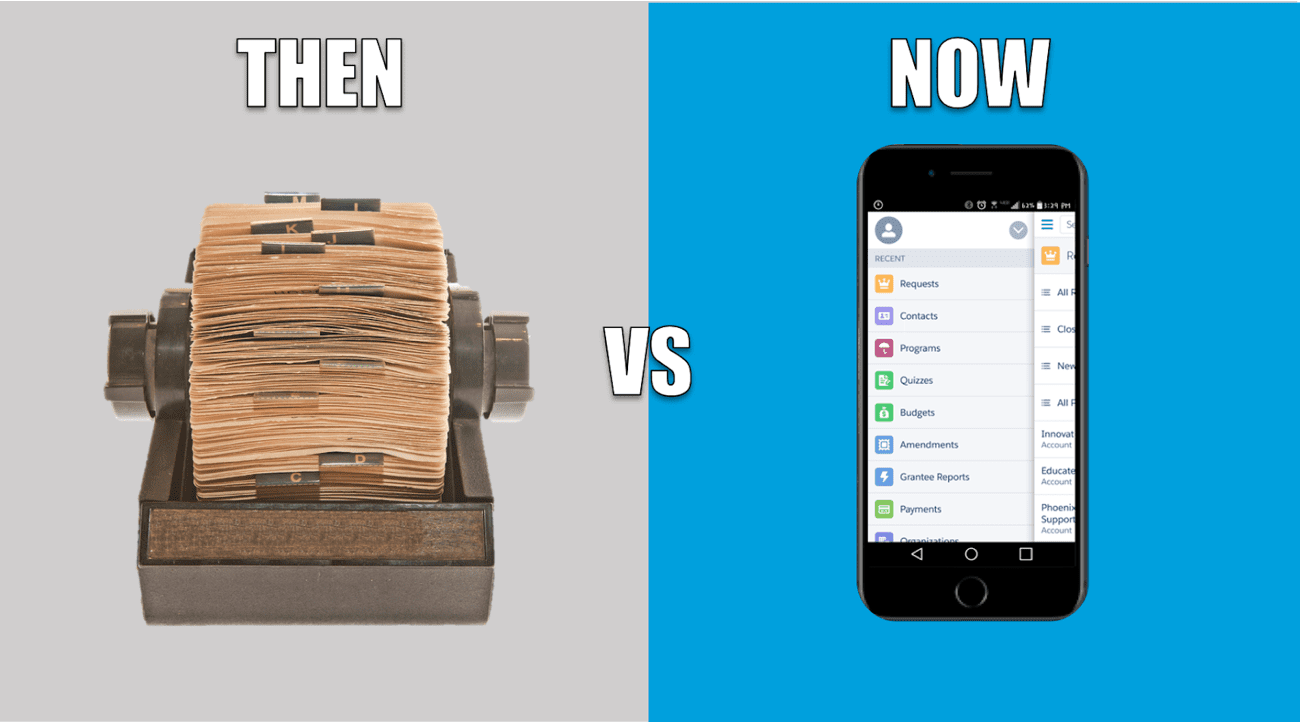
We often take for granted the technology that is now at our fingertips, forgetting what life was like years ago. When an event like this occurs, it is an opportunity to reflect upon how far we have come—from the days of the rolodex (for those of you who remember it!) to the omnipresent smartphone, complete with its plethora of apps. The evolution of technology has allowed us to change the way that we work, empowering us and giving us more flexibility than ever before.

Photograph comparison of rolodex and smartphone

In the nonprofit space, software for foundations has evolved over the years to better serve the needs of grantmakers and grantseekers. It is no longer about a point-solution installed on your computer. Innovation enables you to create a cloud-based technology stack using the solutions of multiple vendors that are, ideally, integrated on a single platform. Salesforce.org is the leader in this area for the nonprofit space, as they leverage the millions of dollars that they have invested to create sophisticated solutions for the for-profit world and give nonprofits access to them.

The Partner You Need for What’s Next

This is an exciting time for nonprofits and for those who serve them. Along with my colleagues at Exponent Partners, I can’t wait to see what’s next! Contact me if you’d like to discuss the Salesforce.org acquisition of foundationConnect in more detail.  If you’re a grantmaking professional attending the PEAK2019 conference in Denver, be sure to come find me in the Exhibitor Hall, too.

New System: Build Capacity in Education Organizations

In today’s funding environment, education organizations are being pushed to do more with less, and fundraising is becoming increasingly competitive as funders are no longer satisfied with case studies and anecdotes of success. These important stakeholders are demanding data around student outcomes and proof of an organization’s effectiveness. This situation leads overburdened staff to complete complex, manual processes related to tracking student intake, enrollment and participation in the organization’s programs, while measuring progress and providing sophisticated reports to funders.

Not surprisingly, in response to this pressure, many organizations choose to expand their use of technology to reduce the burden on staff, better track students, and gain insights into their results. The impact of these systems includes increased funding, expanded capacity, improved reporting, and a deeper understanding of which program strategies are leading to student outcomes. By automating manual processes, removing data silos, and centralizing your nonprofit’s information, your staff can focus on the real mission: helping students and families.

But where to start when you’re trying to identify the best system for your needs? We’ve put together a checklist that will help you in your research efforts. (We created this list with education organizations in mind, but the steps are also applicable to other nonprofits that are looking to build capacity by implementing technology.)

Checklist: Preparing for a New System

  1. Identify the top organizational process(es) you want to automate or expand with technology.
  • Which processes are mission-critical?
  • What processes currently limit the reach of your mission because of lack of resources?
  • What type of services could you be offering to further your mission if you were able to incorporate additional technology?
  1. Define the goals of your system.
  • What would success look like for your system?
  • What pain points/challenges are you trying to solve?
  • What are the benefits (like time savings, new or improved services, expanded reach) that you are hoping to achieve?
  1. Map the organizational process(es) you want to replace/introduce with technology.
  • What are the steps that your staff takes to complete your processes?
  • What information is collected and from what sources?
  • What systems are you using to complete these steps?
  • Who are the internal and external people involved in the processes?
  1. Determine your budget and timeline.
  • How much can you spend?
  • How soon do you need to roll out your new solution?
  • If your budget and timeline don’t allow for what you want, what are your highest priorities?
  1. Make your business case and get buy-in.
  • How much time, money and/or staff capacity can be saved with your new technology solution over time versus how much you’ll spend now?
  • What new services can you provide your students, and what will be the additional impact?
  • Who are the key stakeholders?
  • How will you track the impact of the system and who will be responsible for this?
  1. Identify and select your technology partners.
  • Who should be involved in the selection process?
  • What information do you want from each potential technology partner (examples: delivery methodology, technical features, price of implementation, maintenance and support)?
  • How will you gather this information (examples: formal RFP, informal meetings, demos)?

This checklist is a great framework to use during your system evaluation process, but the proof is in the pudding. For examples of systems we have built for our education clients on the Salesforce platform, please read the success stories of KIPP Foundation, and OneGoal.

Observations from 2018

Post By: Rem Hoffmann

My interactions with clients, prospects, colleagues, partners, leaders and influencers in the nonprofit space have been a source of inspiration for me over the past 12 months. I am constantly reminded of the purpose and meaning behind our work: creating impact.

As the year comes to a close, I would like to share two of my observations from 2018, as they signal a broader understanding of how technology can be a game-changer for nonprofits of all sizes.  

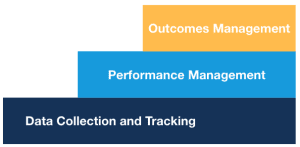
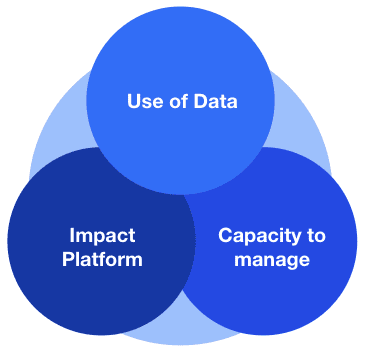
First, there is a clear shift in mindset as organizations accelerate their use of technology to measure and achieve impact. In prior years, organizations have looked at information systems functionally to support fundraising, marketing, and programs operating in silos, rather than in a coordinated way. Now, the conversation has expanded and evolved to address whole-agency solutions that support all of these important areas. The jury is no longer out: transactional, point solutions are inadequate when trying to serve the broader needs of the organization with a bigger picture goal of achieving impact. The need for integrated impact platforms, which truly help changemakers use data for impact, is becoming more widely understood and is being embraced by nonprofits across all categories—from human services agencies to education changemakers to foundations.

Second, for those organizations that have made the commitment to implementing an impam ct platform, there is a growing appreciation for the capabilities and skills required to get the most out of these investments. The journey toward using information systems in a high-impact way increasingly means building the team, the knowledge, and the processes to manage information systems well. Information systems management requires different capabilities at different levels, going beyond system administrators to include processes, tools, and skilled individuals individuals who will operate, manage, and expand that impact platform over time. Change management, systems adoption, user training and support, systems administration, data and security management are all examples of the core competencies that organizations must look to acquire.  As the use of impact platforms becomes more sophisticated, the management of this technology must follow suit. Software and tools are important pieces of the puzzle, but another piece—staffing and processes—is now garnering the attention that it deserves. Many nonprofits now recognize that in order to create and fully leverage an impact platform to manage operations, achieve high performance, and strive for outcomes, they need certain elements in place.

I am personally excited to witness this change, and to be part of this transformation of our social sector. As changemakers, all of us at Exponent Partners believe that these two ingredients—impact platforms and capability in managing them—must be combined with a third one to support an organization’s success and social impact. So much so that they are are enshrined in our own organizations’ theory of change.

That third capability lies in the use of data. It is progress in this area  that gets me fired up! All across our incredibly diverse nonprofit sector, we are seeing increasing attention to how information is used to support, grow, and accelerate social impact. In our work, we see more sophisticated methods of visualizing and analyzing data, applying machine learning to data sets of program interventions to generate predictive and prescriptive information, and generating evidence of program performance and success. In our clients and partners, we are seeing evidence of an increased focus on using information well. Often this takes the form of new position titles, such as Chief Impact Officer, Data Scientist, and those that I often—tongue in cheek, of course!—call the “ampersand positions”: Monitoring & Evaluation. Data & Learning. Knowledge & Outcomes. These positions indicate that the organization is going from being a transactional user of technology—where data is only being tracked and reported—to managing and leveraging data as a strategic asset.

As I look forward to 2019, I am optimistic and energized by the change, the opportunity, and the social impact that lies ahead!

Rem Hoffmann

Founder and CEO

Rem brings expertise in professional services rigor and product excellence from his experience building and leading a 150-person IT services team in Washington, DC. In this capacity, he designed, marketed, and operated large-scale IT outsourcing programs for government and commercial clients, inclu...

TAG Conference 2018 – Impressions

I was fortunate to have attended the TAG 2018 Annual Conference last week in Tucson, AZ. As I expected, it was an incredible opportunity to network, explore and learn alongside others who are committed to philanthropy and technology. And what a beautiful location for this fantastic event.

Photo Source: https://www.tag2018.org/photos.html

TAG kicked off with an incredible keynote by Larry Irving, a well-known and highly-regarded technology strategist who coined the phrase “digital divide” while in the Clinton Administration. Larry’s keynote was a great launch point into the conference as attendees had an opportunity to consider and discuss how they could use technology to truly change the world. Indeed, access to technology is a game changer in society and can transform the way people think, vote and live.

However, much of the philanthropy space is still talking about tactical solutions to solve operational challenges. Some are leveling up to integrating technology, processes and staff, so that their organization can gain access to solutions that can measure impact and foster positive and inclusive experiences for grantees. It can be challenging to make this kind of change in an organization, especially since the philanthropy culture changes slowly. (In fact, an entire session was dedicated to the topic of making change!)

There were also several sessions about effective project management and unique methodologies to develop positive user experiences. We were encouraged to hear a great deal of discussion about Salesforce and its benefits as a platform. Equally as exciting was that it was standing room only for the session, “Choosing a Platform for Philanthropy: Grants Management and Beyond,” which was hosted by Exponent Partners’ very own Steve Andersen. This popular session featured speakers from Hewlett Foundation, Chan Zuckerberg Initiative, and Heising-Simons Foundation, all of whom shared their positive experiences using the Salesforce platform. There was a great deal of picture taking happening when each speaker displayed details about the many applications they use in their solutions! (One of our clients, Campbell Foundation, uses many of the same apps. You can find out more in our case study.)

But, for me, the biggest aha moment came when the report, Investing in Impact Infrastructure, was released at the conference. YES! The report aligns with our strong belief that leaders in philanthropy need to start investing in technology in order to maximize their organization’s impact.

This report is definitely a great start towards promoting the shift from finding solutions that will solve operational challenges towards defining approaches that document and measure key impact data. As the report says, “The current state of philanthropy requires a more integrated holistic approach.”

Frankly, we couldn’t agree more.


New york landscape

Breakthrough New York Manages Student Lifecycle with Salesforce

Our client Breakthrough New York prepares motivated low-income students for college graduation with a transformative program that includes a 10-year commitment from sixth grade through college. How do they maintain high-quality student support and program operations over this extensive lifecycle?

We were excited to hear Breakthrough New York share the story of how they recruit, manage applications, provide student support, and track progress effectively. Their recent full adoption of Salesforce has helped them increase their efficiency in numerous ways.

Amy Cruz, Chief Operations Officer at Breakthrough New York, remarks, “When I started at the organization, one of the apparent needs of our team was being able to use time more efficiently and productively on the quality of support that our students and our families needed. Once I observed the team in action, for me that meant: not spending our time on Google Sheets, not spending our time creating and recreating Excel templates. That’s what led me to Salesforce.”

Managing Program Results from Beginning to End

Breakthrough New York has seen tangible, real results from their new Salesforce program management system in their first season since launching. The system has helped Breakthrough program-wide, from initial application to student performance management.

Initial Application Process: Previously, six Breakthrough New York staff members spent three weeks, or 240 hours, collecting, collating, and processing applications. Now with Salesforce, two staff members spend three days or 48 hours processing, with hopes of getting that number down to even less next year.

“The new application functionality has been an absolute game changer and has allowed us to expand to more students than ever before, and process more quickly than ever before. The automatic email about missing materials has been especially efficient,” says Natalie Cox, Senior Program Director at Breakthrough New York.

High School and College Application Process: Previously, staff spent the majority of their time following up on student to-dos and chasing down submissions. Now with their new system, staff focus only on the quality of applications, such as essays and interview preparation. The system is set up to auto-remind students of outstanding tasks.

Student Support and Opportunities: Previously, student support situations and college access opportunities existed in individual email accounts or staff members’ memories. Now, they are shared across all staff in Salesforce, giving them a historical record of student needs.

Managing 10 Years of Student Performance: Previously, success metrics were undefined and unaligned. Building their Salesforce system helped Breakthrough New York be more explicit about defining their metrics and what was important to track overall along the 10-year timeline.

Walking Through Breakthrough New York’s Salesforce Student Data Management Solution

Breakthrough New York breaks down their student 10-year journey into a few critical phases:

  • Initial application to Breakthrough New York
  • Student support through middle school (focus on academic support)
  • Student support between ninth grade and last year of high school (focus on socio-emotional support)
  • Student support in college (focus on career support)

Each of these phases contains processes that Breakthrough New York manages through Salesforce.

Breakthrough New York Application Process: The start to the student journey, the Breakthrough New York application, is highly competitive.

Students must meet 6 core eligibility requirements (such as being a current 6th grader in a New York High School), and 2 out of 4 of another set of requirements, such as being an English language learner and being the first in their family to attend college. Student selection is also based on applicant scores from essay responses, recommendations, interviews, and in-person observations.

Breakthrough New York leverages FormAssembly, a third-party app that Exponent Partners integrated into their Salesforce platform, to collect and track all students’ application materials in one accessible place. The FormAssembly application features:

  • A link that any sixth-grader can use to apply for the program
  • Basic information tracking, such as contact, demographic, and other information that program managers need internally and for funders
  • Questions that meet and trigger basic and complex eligibility requirements, such as the middle school they attend, and how they performed on state test scores
  • Household and income information tracking
  • The ability to upload proof documents directly like test scores, report cards, and income documentation
  • A second unique link for students to fill out the qualitative portion when deemed eligible
  • The automatic sending of a link and form for a teacher recommender to submit when the student enters a teacher email

When students enter their application in FormAssembly, it is immediately entered into Breakthrough New York’s Salesforce back-end as well.

Within Salesforce, staff can track student applications at a glance by opening a view that shows all application statuses, alongside name, overall scores, eligibility status, location, and more. From there, they can drill into individual student records to view more details such as receipt of their documents and qualitative responses.

Rather than staff manually entering each application and sorting thousands of documents, they can dedicate more time to assessing qualitative responses. Also, they can more easily see an overview of the applications and the quality of candidates they are receiving.

For recruitment purposes, they have a unique link to the application they can easily share via email, mailings, social media, partner communications, and more.

Student Support (Academic, Emotional/Social, & More): Breakthrough New York tracks academic data like student grades, test scores, and attendance in Salesforce on the student record. This helps them see where they can provide support at each stage of the student lifecycle. They track how students are performing in the Breakthrough New York program as well as their current schools.

Staff can also manage mass data, such as summer program attendance. With a tab showing a view of Breakthrough New York sessions, they can enroll an individual student or many students, see an attendance roster of a given day, and keep track of homework and meals. From this view, they can also drill down into an individual student’s attendance and performance. They use a similar format to track school grades, school attendance, school enrollment, and opportunities.

The format works for other custom aspects of their program. For one facet of social/emotional support tracking (a later focus of the journey), they worked with Exponent Partners to create an object called “Risks,” which tracks individual student issues. A staff member can note an issue like bullying, rank its severity level, and note whether it is active or resolved.

Tracking College Access Opportunities Throughout Program: Students in the Breakthrough New York program have varying opportunities at different stages of their journey, such as internships and scholarships. Salesforce allows Breakthrough New York to more easily note and share out the criteria of a given opportunity (deadline, location, compensation, etc), and track eligibility. If a student applies, staff can track them as one applicant on the opportunity, and see how many students total are submitting to it.

This tracking also helps when students are completing their college applications, as they have a history of extracurriculars that are tracked on their individual student records.

Monitoring Student “Health” Annually: With Exponent Partners, Breakthrough New York created a feature called “Pathways” that shows the overall aggregate rating of a student as a color: green, yellow, orange. These display when a student struggled or did very well, and are tracked for each year. This provides an at-a-glance view of what students accomplished at the end of the year, based on aggregate milestones, paperwork, and expectations.

Cruz recommends, “Choose a data system and build it. While you’re waiting for the perfect system, it never really comes along. You have to create it. Make it a priority, and take the time to build the system that will help your staff support your students in the best way possible.” Learn more about Breakthrough New York’s program management on Salesforce and see their live demo in this webinar.

Salesforce.org Takes on Program and Impact

Salesforce.org is moving into program management and impact management with intentionality, and that is big and welcome news for all of us who work in the social change information systems ecosystem!

A key promise of the Salesforce platform is that it enables a nonprofit organization’s ‘whole agency’ strategy, where all key business processes are creating useful information in one integrated system. This is such a departure from the more typical proliferation of data silos that it is hard to understate the importance of this platform. And this is what makes the Salesforce platform such a compelling improvement over legacy point solutions like Blackbaud and all the other smaller fundraising, marketing, and communications systems.

This increased focus on program management also opens up the door to social impact measurement, monitoring, and management. Impact – social impact, impact on a community, impact on a neighborhood – is achieved by changemakers in the nonprofit sector who design and deliver great programs and great program outcomes to their participants. Extending the power of the Salesforce platform to this indispensable part of an organization’s social mission will also enable increasingly sophisticated and real-time connections and analyses between ‘what works’ and ‘what it costs’.

Dreamforce 2018 provided a wealth of experiences and announcements where this focus on program and impact was evident.

Roadmap

In the Salesforce.org Product Roadmap for Nonprofits session, SFDO’s Lori Freeman, who leads nonprofit product management, unveiled the roadmap for Salesforce.org across three domains: fundraising, engagement, and program. Shelly Erceg, the program management director, then focused on the program roadmap. And while it is certainly early in its development, it is clear to see that the emerging framework starts to pick out vital capabilities, like case management, program management, services management, and impact measurement (all of which are part of Exponent Case Management (ECM), natch!), in addition to volunteer management, project management, and call center capabilities. A key takeaway is that program management is now finally given equal billing with the traditional strengths of the Salesforce platform in fundraising and engagement. And that is a welcome development indeed.

Sessions!

The tone was set with the nonprofit keynote – Become an Impact-First Nonprofit. There were more sessions focused on program management than at previous Dreamforces, especially in the human and social services domains. Considering that these types of organizations represent more than one-third of the nonprofit sector, this is good to see. Just among Exponent Partners ECM clients, we had great representation. Sandy Allen of United Way Bay Area demonstrated her organization’s deep knowledge of program management, evaluation, and impact in her talk on planning for systems change. Kai Harris at California Human Development talked about using program data to go beyond backward-looking reporting and to start looking forward with data through diagnosis and prediction. Program and impact were everywhere.

Tools

The new capabilities in Einstein Analytics and Einstein AI are directly supportive of the work of program management and impact management. Analytics are vital in describing, building shared understanding, and working to continuously improve ‘what works’ in programs (i.e. what social interventions are effective for what participant). Einstein AI will enable machine learning applied to our clients’ program management data sets, and tease out the learnings and insights about which interventions should be applied to which participants in what situations and contexts. This ability to provide predictions and prescriptions right within program staff’s case management application represents a leap forward that other point solutions just cannot match.

These are early days in program management for Salesforce.org, but all the signs above are incredibly encouraging and point to a bright future for salesforce.org, our partner ecosystem, and especially for the nonprofit organizations which look to us to help build their social impact and program success! Onwards and upwards!

Dreamforce Lightning Flow Builder

Dreamforce Roundup

The annual Salesforce user conference finished up on Friday, September 28 and, once again, it was an amazing spectacle. Somewhere north of 150,000 people flooded session rooms around downtown San Francisco, all there to learn about some aspect of the Salesforce platform.

My first Dreamforce was in 2006, when I was one of 5,000 attendees. That year marked the launch of Apex, the Appexchange (it had over 400 apps!), sandboxes, validation rules, the new Classic user interface, and so much more. The keynote let us watch Marc Benioff log in on stage, head over to Setup, and configure Salesforce. It was quite a different world from 2018.

Dreamforce is a splashy event, and so there are always some big announcements. But because Salesforce has three releases per year, Dreamforce isn’t a big-bang announcement-fest like events held by other companies, such as Apple. There’s often some interesting new services, partnerships, and features announced, but we get used to the drumbeat of new features in October, February, and June each year, so sometimes Dreamforce can be a bit less dramatic than it seems from the outside.

Here are some of the interesting announcements  from this year’s Dreamforce, plus a few others that were revealed over the summer.

Low Code Tools

From the start, Salesforce has had point and click tools to customize and automate the platform. There are two new low code tools that are interesting:

Lightning Object Creator allows you to turn a spreadsheet into a Salesforce application without any code. If you use spreadsheets for a process, you can drag and drop them into the Object Creator, review fields for accuracy and publish a digital form, available on desktop or mobile. You can further analyze the data or add it to existing records with support for Search, Notes or Files within Salesforce. Check out the blog post for additional details.


Lightning Flow Builder is a revamp of Flow Builder, which helped us all create drag and drop processes, forms, and automation. The look and feel of Lightning Flow Builder has been matched to the Lighting Design System, giving us a level of familiarity that improves the user experience. In addition, Salesforce announced Flow Actions – pre-built, reusable components that can be dropped into any Lighting Flow. Lighting Flow Builder and Process Builder have some overlap in what they can do–it’s clear that Lightning Flows is where R&D energy is going at the moment. Here’s a Trailhead that may help you better understand when to pick one over the other.


A New Lighting Page Layout Editor is coming in the future, and will include ways to filter out blocks of detail content based on context. While information is limited at this time, it’s hard not to get excited about what this blog post says is coming–the power of having sections of a page render or not render based on data, user, etc. We’ve been wanting this capability on the platform since day one, and we’ve had to use Record Types as our only recourse other than a full UI rewrite. I’m excited to learn more!

Google released the Data Connector for Salesforce, a free add-on for Google Spreadsheets that allows you to query, create, and update Salesforce data right in a spreadsheet. While there are existing, similar tools, the fact this is put out directly by Google is interesting. I’ve used tools like this to do very complex data manipulation in a spreadsheet while maintaining the benefit of data directly linked to Salesforce. Simply press a button and your data is refreshed from your CRM. It’s worth trying out the Data Connector–my only issue with it is that it will only pull 2,000 rows from Salesforce reports, leaving you with incomplete datasets. For very large data sets, you can write SOQL queries, or use a tool like Xappex’s G-Connector.

The Einstein Family of Products

Salesforce kicked off Dreamforce with the announcement of Einstein Voice. The next version of the Salesforce mobile app on iOS will be able to take dictation, help you smartly connect that note to records it has discovered in your note, and even create or complete Salesforce Tasks. It’s a pretty cool piece of app functionality.

You will be forgiven if you’re not sure how this fits together with everything else that falls under the Einstein family of products. Think of Einstein as Artificial Intelligence on the platform, and you’ll be mostly there. Each of the core areas of Sales, Service, Marketing, Commerce, and Community have turnkey tools that can be used to apply artificial intelligence in smart ways to solve common problems. In Sales, for example, Lead Scoring uses artificial intelligence to prioritize the Leads that are the most likely to turn into deals. There are about 15 of these out-of-the-box AI components listed on the Salesforce Einstein product page.

In addition to those turnkey components, there are a number of Einstein services created for platform developers. These services allow developers to build their own AI tools to work with Salesforce. With Prediction Builder, Language, Vision, and Bots, developers can tune AI for use cases that are unique to their industry or  specific needs. We are very excited about Prediction Builder. Lead Scoring for salespeople is a nice feature too, but we’re much more interested in the possibility to use AI to identify the right interventions for kids receiving services from a direct-service nonprofit. This is an exciting toolset on which to build really smart software, and we are just at the beginning of this journey.

The final member of the Einstein family is Analytics, and it really is different from the others.  Formerly called Wave, Analytics is a data visualization and dashboarding solution. It has an AI component called Discovery that analyzes large data sets and helps see connections between data that might not be clear at first glance. But all in all, Analytics is more about data and dashboards than AI.

A Million Other Things

Salesforce.com spends around $1B on R&D every year, so it is impossible to note every improvement they have made, even in the last few months. All you have to do is watch this DX Super Session to see how many new technical aspects of the platform can be jammed into a 40-minute presentation. It’s remarkable, and a big reason we love Salesforce–it’s being driven forward by an economic engine much larger than the nonprofit sector could ever generate, and we get to take advantage of all of it. The hardest part is keeping up!

Dreamforce Braeden Blog

Dreamforce Through the Eyes of a Rookie

Unlike my colleague, Sean Speer, I’m not a Dreamforce veteran. Truth be told, I’m a Dreamforce rookie and 2018 was my first time attending this epic event. It certainly won’t be my last!

As I prepared for the event, I wasn’t sure what to expect, so I reached out to a few of my teammates for advice. Everyone mentioned that I would be blown away by the sheer volume of people at Dreamforce (and I was), but then came the practical tips. Wear comfortable shoes. Attend as many sessions as possible. Learn what’s new with Salesforce and what’s around the corner. Take time to visit the booths of other companies and listen to their presentations. Be a sponge and soak up as much information as possible.

This sound advice helped me make the most of my first Dreamforce experience. The event definitely surpassed all my expectations, even though I missed the concert with Janet Jackson. Sad face.

One of the most memorable aspects of Dreamforce was standing alongside my colleagues, watching them team interact with customers. No matter what questions or difficult problems customers threw at them, my teammates responded confidently, leveraging their in-depth knowledge of the Salesforce platform. I was left inspired to dive deep into everything Salesforce has to offer.

Among the various sessions that I attended, my favorite was with Dr. Vincent Matthews, who is the SFUSD Superintendent. He spoke about equity equaling equality, and supported this theme with a tangible example. Specifically, he showed a photo of three children as they tried to watch a baseball game. One of the children was very tall and had a great view; the second was average height, so could see the game by standing on a one-step stool; and the third child—the youngest and shortest—needed a stool with three steps in order to watch the action. Dr. Matthews explained to the audience that not every child has the same abilities as other children, but that does not mean that they can’t reach the same goal, which, in this case, was watching the baseball game. Indeed, in a classroom setting, some kids need no help, some need a little, and some need a lot. Everyone is different and has their own strengths and weaknesses, but with the appropriate help, they can all reach the same goal. This effective example reminded me of the impact that we can make on people’s lives by giving them the tools they need to succeed.

I wrapped up Dreamforce over a debrief dinner with my colleagues on Thursday night. As we shared our learnings, favorite moments, and insights, I was reminded how lucky I am to be part of the Salesforce ecosystem. I’m already counting down the days to Dreamforce 2019!