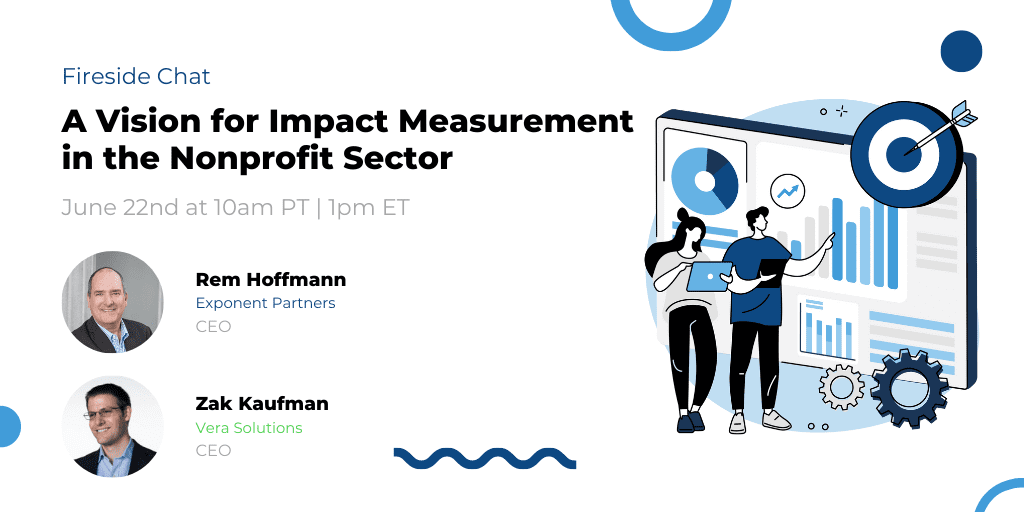
Graphic depicting speakers at Fireside Chat

Valuable Impact Measurement Insights

Rem Hoffmann, CEO of Exponent Partners, and Zak Kaufman, CEO of Vera Solutions, came together for a lively fireside chat discussion on June 22, 2022. Rem and Zak’s goal was to share their views of the present and future state of impact measurement in the nonprofit sector and talk about why Exponent Partners and Vera Solutions are working together. Moderated by Rachel Hands, Director of Success Center at Exponent Partners, the fireside chat touched on a number of important issues relating to social impact information systems, change management, what the future holds, and what organizations struggle with today. Let’s dive into some of the key takeaways from Rem and Zak’s chat.

Exponent Partners and Vera Solutions: Strategic partnership

Rem and Zak shared how their organizations have partnered as a way to drive change in the nonprofit technology space and further their closely aligned missions. Both Exponent Partners and Vera Solutions are committed to driving social impact through their mission alignment, focus on collaboration and industry expertise. Rem shared, “We’re very similar organizations and also highly complementary. On one side, we have the same social venture DNA. We have a very similar social impact measurement focus in our respective missions, and interestingly we both build information systems products that bake best practices into software.”  Curious to learn more? Check out Exponent Case Management and Amp Impact.

What Rem and Zak are excited about

Rem shared that he’s most excited about the shift from individual technologies or tools to more centralized information systems. This is a big move in the right direction for organizations and allows them to create a sustainable method of generating value from their data. Rem likened it to enterprise performance management, essentially taking silos of data and turning it into information that will give you value by demonstrating your impact. Zak agreed with Rem and also shared his excitement about the people and momentum in the space. “The proliferation of talent in this space, the momentum around the data for social impact space as some call it I think is really tremendous.” Zak also shared details about a new report from data.org entitled ‘Workforce Wanted: Data Talent for Social Good’ that looks at the opportunity to shape and support a pool of data professionals focused on social impact over the next ten years. Check it out here.

Biggest opportunities for change

Rem described a gulf between how nonprofit organizations collect data and then use that to tell stories about their social impact. Simply implementing a technology or tool isn’t enough to get you there. There is an additional challenge to get leaders and outcomes experts to look at data collection and impact measurement the same way and get true alignment in place. According to Rem, every organization should have an information systems strategy directly tied to their theory of change. This will allow for better decision-making with respect to bridging that gulf between data collection and true impact measurement. Zak highlighted that some organizations are shortcutting the data management part of the process, which undermines the sustainability of systems. A challenge here is often related to internal capacity and capabilities. Technology tools are broadly accessible, but capabilities and people can be the hard part for many nonprofits. Investing in capacity building in the nonprofit sector needs to be sustained in order to address this systemic challenge.

Interested to check out an on-demand recording of the full fireside chat discussion between Rem and Zak? Find it here.

Exponent Partners Social Change

Exponent Partners’ Purposeful Commitment to Social Change

Post By: Rem Hoffmann

At Exponent Partners, our purpose is to help nonprofits achieve greater social impact through radically better use of information systems. From our inception, we’ve worked to create long-term partnerships with nonprofit organizations that are committed to positive, progressive, systemic social change. Exponent Partners’ vision of a just and equitable society demands social changemakers as powerful as business and government. The actions in the last 24 hours by the Supreme Court in overturning Roe v. Wade, politicizing gun control, and overtly threatening gay marriage rights proves how essential this strength is. So it is especially important at times like this that our actions and decisions are aligned to our core values of diversity, learning, innovation, and impact, and to our core purpose of supporting social changemakers with all our work. And as a B Corporation and a California Benefit Corporation, we strive to hold our organization to the highest standards for social performance. 

We stand with the change-making nonprofit organizations that are working tirelessly to eliminate systemic barriers of oppression and to fix what’s broken in our society. We are dedicated to investing in the work that fosters true systemic social progress. As a social venture working for nonprofits, we support the changemakers who are making a difference in their specific areas and with the communities they serve.

It is easy to feel overwhelmed by world events right now, and to not know whether your individual actions can make any difference. For us, working closely with our changemaking clients and supporting them to do more of the critical work they do helps us stay aligned with our purpose and our values. We will continue to work tirelessly to support our nonprofit clients because seeing them increase their social impact is our way of working toward a more just and equitable world. 

Rem Hoffmann

Founder and CEO

Rem brings expertise in professional services rigor and product excellence from his experience building and leading a 150-person IT services team in Washington, DC. In this capacity, he designed, marketed, and operated large-scale IT outsourcing programs for government and commercial clients, inclu...
Salesforce Summer Release

Everything You Need to Know About the Salesforce Summer 22’ Release

This Salesforce Summer Release 22′ recap is brought to you by Exponent Partners’ Customer Success team.

It’s that time of year again: Salesforce is releasing another new version of their platform. This time around, we’ll get to see a bunch of cool new features and functionality—but before you go searching for them, take a moment to really consider what they mean for you as an admin or developer. And if you’re a user, don’t forget to check out the features coming your way and to pass this along to your Salesforce system administrator!

When will the release happen? 

There are three possible dates where the release may affect your organization. So you might be wondering: How do I find the exact date when the upgrade is scheduled for my org? 

On the Salesforce Trust site, you can check the Maintenance Calendar to look up your org instance or domain to crosscheck for the exact day the release will update in your instance.

It will be one of these three dates: 

  • May 21st, 2022
  • June 4th, 2022
  • June 11th, 2022

So what are some top features in the Salesforce Summer 22’ release to keep your eye out for? 

Custom Address Field

A custom address field that functions in the same fashion as the standard address field but you will need to have state and Country/Territory picklists configured first. Otherwise, the new field isn’t available. 

Filter Related Lists

You can now create custom-related lists that can be filtered to display only when particular criteria are met. This is configured as a new component for Lightning pages: ‘Dynamic Related List – Single’.  You can configure which fields are displayed, the order they are displayed, the number of records to display, and select which actions are available. 

Do More With Picklists

If you love productivity, you’ll enjoy the new functionality to delete, deactivate, activate and replace multiple custom picklist field values at once!  

Productivity lover you say? What’s even better is that you can now receive an email when custom picklist fields have more than 4,000 inactive values instead of checking each field individually. You can also bulk delete the inactive picklist values in custom picklist fields. Lastly, instead of just noting that there is a duplicate picklist value when you are adding a new picklist, the error message will tell you which value is a duplicate.

Just remember to opt into Advanced Picklist Values Management (Beta) in Picklist Settings under Setup to use these new picklist features. 

Do More With Reports

If you want to limit the number of results showing in tabular reports, you can now set a row limit so only the first X records show in Lighting Experience. Be sure to sort by a column first so the option to add a row limit becomes available. 

Summary functions now include Median as an option and you can edit multiple fields and rows inline in a report without needing to rerun each time.

Highlight Feature: Sort Report Types by Object

You can now filter on specific objects when creating a new report. This service is in Beta, but you can still try it out! 

Highlight Feature: Customize Cumulative Rollup Names

In the Summer ‘22 release, you are now able to customize cumulative rollup names. This means that you can change the label of a cumulative rollup. This does not impact regular rollups, which already have this capability.

Marketing Cloud is rebranding!! So who’s that feature? Here are some changing terms to keep your eye on: 

  • Messaging/Journeys/ → Marketing Cloud Engagement
  • Interaction Studio → Marketing Cloud Personalization
  • Datorama → Marketing Cloud Intelligence
  • Salesforce CDP → Marketing Cloud Customer Data Platform
  • Advertising Studio → Marketing Cloud Advertising
  • Pardot → Marketing Cloud Account Engagement

So how can Salesforce System Admins prepare for this release?

Get started by reviewing these detailed released notes.  It’s important to know how and when features become available.  In preparation, we highly recommend bookmarking the feature list as a quick reference to find out what is enabled for all users, enabled for system admins, if it requires direct action before users can benefit from the feature, and what you’ll need to contact Salesforce to enable. 

Be sure to register for a Salesforce My Domain if you do not already have one since the Summer release will require all organizations to have a My Domain. If you don’t have a My Domain, then claim and register your brand name. Claim your domain name now and deploy it in your sandbox later. Learn more about My Domain here. 

Then get ready to have some fun by exploring the new picklists setting in the setup tab. Look around this tab and activate any beta features you want to test out for your organization. Lastly, be sure to address any pending critical updates which can be found in Setup. 

If you have questions about any of these updates, our customer success team provides regular updates on Salesforce releases and can help you understand what these changes mean for your organization. Contact us to learn more about our customer success and managed services offerings. 


Signs Your Organization Should Consider a Virtual Salesforce Admin

Hey, reader. We see you. We see that you’re struggling, that you’re overwhelmed, that quite possibly you didn’t realize you would be acting as your organization’s Salesforce admin on top of your other responsibilities, yet here you are. A common way to describe your role is “ad hoc admin”. And trust us – you are definitely not alone! We understand where you’re coming from because we’ve been in your shoes. Basically, we would love to help you get some support. This support may come in the form of working with an external virtual administrator (also known as virtual admin or “VA”). A virtual admin is a very real person whose job is to help you focus, prioritize, and execute on changes to your system, reporting, keeping up with system upgrades, and generally keeping your users happy. Is it hard to know whether working with a virtual admin is the right move for you? Let’s start with some of the most common pains that Salesforce admins at nonprofit organizations face and then talk about how enlisting an experienced and knowledgeable VA can help you overcome them. At the end of the day, you are not alone and it doesn’t have to be this way! Read on to learn more.

You’re constantly reinventing the wheel

Many ad hoc admins can get stuck in the cycle of having to continually invent – or reinvent – ways to address issues with their system or handle requests as they come up. This can lead to frustration, burnout, and inefficient or overly complicated processes. (See our second point below.) An experienced virtual admin has a perspective that’s informed by their work with many other organizations in addition to their specialized training. They know what’s been successful for organizations like yours, so you don’t have to feel like you’re starting from scratch every time. Virtual admins help align your organization with best practices and offer a helpful perspective based on their wide range of exposure to other organizations.  

Your organization has complex needs

Salesforce environments in the nonprofit space can be a labyrinth to navigate; full of complicated automations and a lack of knowledge or documentation about why things are the way they are. It’s super common for urgent issues to push that critical documentation or important big-picture item to the back burner. The impact of that is often felt much later: when you have staff turnover, or need to adjust something you built a year ago and can’t remember why you decided on that particular approach. This can make it very hard for internal admins to see the forest for the trees, scale up effectively or make the best decisions about how to align ad hoc requests with the overall business objectives. Virtual admins can help break through some of these barriers and identify the best ways to streamline and optimize your environment. Additionally, they consider the ripple effect of any updates or changes to existing automations, helping ensure you can get the result you need without making things even more complicated.  

Too many cooks in the kitchen

A lot of organizations, particularly smaller to medium-sized ones where staff are asked to wear lots of different hats in order to make the most of limited resources, have too many Salesforce users with the ability to change settings and access admin-level processes in their environments. This can result in people inadvertently working against each other, duplicating work or creating environments that are increasingly difficult to navigate, especially for new staff. Virtual admins can help put structure and process around any admin-level change to the Salesforce environment, with a goal of making things easier rather than more complicated. Having a specialized expert owning the administration of your environment will help keep things on track when things pop up, which they always do. Virtual admins can help keep the executive needs, user needs and system all aligned and ensure that any changes in setup are carefully considered.   

It’s hard to measure your impact

Nonprofit organizations, particularly in human services, often struggle to produce the data or reporting needed to accurately measure and demonstrate their impact. Measuring and demonstrating impact is critical when it comes to accessing funding or grants that help keep critical programs running. Ad hoc admins are often so overwhelmed with user-level requests and keeping the lights on (so to speak) that aligning the system to effectively measuring impact can feel like too much to manage. In comes the virtual admin! Virtual admins can provide the critical professional guidance and best practices to help organizations get out of the weeds of the day-to-day and focus on what matters most for long-term sustainability: measuring and demonstrating their social impact. 

If the points above strike a chord with you, then perhaps it’s time to talk to your leadership about working with a Salesforce virtual administrator. Interested to learn more about the virtual admin services offered through the Customer Success Center at Exponent Partners? Check this out. Better yet, reach out to us.  

Program Navigation Workflow

Program Navigation Fosters Program Fidelity

Post By: Josie Alleman

“Even the smallest organizations can find ideas…that allow them to know whether they’re making a difference or not. That’s a reasonable minimum requirement for anyone who aspires to do good, applies for charitable status from the IRS, and asks others to commit their money or time,” Mario Morino aptly said in Leap of Reason. In essence, he’s saying that if you are using someone else’s money to try to make a difference in someone’s life, you need to be able to show that you can in fact make a difference. 

Yet we know that more commonly, “organizations are drowning in a sea of unactionable data. So they can’t monitor what needs to be monitored crisply, therefore they can’t manage with high intentionality, they can’t learn in order to adjust, they can’t adapt and improve—and they can’t deliver what they promise,” according to David Hunter, the author behind Working Hard & Working Well. These powerhouse authors have led the charge in social sector performance management and we encourage you to read their work in full. As a social venture focused on helping nonprofits drive better impact, we can leverage some of our in-depth expertise to offer an approach that helps organizations monitor their performance levels. One approach that makes a big difference is adherence to a proven program model otherwise known as ensuring high program fidelity.

So, what exactly is program fidelity? “Fidelity is the extent to which an intervention is delivered as intended” or follows a program model, according to research from U.S. National Institutes of Health’s National Library of Medicine. It’s a structure that aims to preserve the components of evidence-based practices that directly impact the success of desired outcomes. In short, program fidelity helps human services organizations reproduce results and understand the elements within a program that leads to radically better outcomes. 

Why is that important you may ask? Even if your program is not evidence-based, program fidelity ensures that the elements of any program model are carried out as intended. Monitoring program fidelity ensures confidence in quality services and allows for easier outcomes measurement. If the services provided do not stay true to a program model, the clients who benefit do so by accident, without knowing how and why. This eliminates the possibility of reproducing it.  Without fidelity, case managers, data analysts, or those working to evaluate and measure outcomes cannot isolate any of the variables to understand their impact. In essence, “knowing if an intervention was implemented as planned is fundamental to knowing what has contributed to the success of an intervention.” 

In addition, private and governmental funders are increasingly insisting on evidence-based practices. As a result, social workers have to be able to measure and report on the success of their model of care. With Exponent Case Management, human services agencies can easily collect and analyze the data needed to enable drastically better outcomes. We’re excited for the latest release of version 18 which includes an updated take on program navigation. 

What is Program Navigation? It’s a system of checks and balances that guides agency staff as a client moves through the program’s model of care. It walks staff members through a series of steps that lead to overarching goals or milestones. A clearly documented process flow, allows them to see when a client meets the required criteria and guides them through the next steps.  In doing so, the fidelity of the program model is supported while simultaneously ensuring compliance with standards. 

How can Program Navigation help your organization? 

  • Program Navigation helps your frontline staff understand the requirements of each stage within a program with ease which in turn helps them to manage their cases. 
  • It ensures that clients are ready to move to the next stage and can help to optimize their success by adhering to a proven model of care.
  • Program Navigation enables consistency of care throughout your programs regardless of which staff member is assisting the client.
  • It allows staff members to reclaim their day with automated workflows and documented guidance at every stage
  • It enables adherence to the program model which in turn will help you measure if the model is effective because data is going collected in a similar manner across the organization. This allows you to compare apples to apples. 
  • Staff members can be alerted and intervene when a client is outside the range of those evidence-based practices. For example, the ideal length of time in a job search. 
  • It enables you to validate theories such as “high-risk teen clients between the ages of 13 and 17 have 30% fewer school absences if they attend 2 life skills classes per week for 8 weeks”. 

The great news is that this newly designed and optimized navigation is already available to Exponent Case Management customers at no additional cost. It’s part of the improvements we continually strive toward to provide changemakers on the frontlines with the right tools to drive change. 

If you want to use Program Navigation to help your staff move through their day with ease while adhering to program fidelity but you don’t have a well-defined model of care in place yet, we can help! Our team of experts can define and create your program process, implement stages, and put everything you need in place in order to track it effectively. Through our strategic planning engagements, we take the time to deeply understand your business processes and build a solution tailored to your organization based on evidence-based best practices. Contact us to learn more or schedule a demo today! 

Josie Alleman

Product Manager

Josie is passionate about helping human services organizations use data to  ensure that the work they are doing is truly making a difference in people’s lives. Her excitement about data in social services started when she was a public health Peace Corps Volunteer in Kenya. She helped rural c...
sms technology chd mogli ecm exponent partners webinar

The Impact of Case Management and SMS Technology

Imagine: it’s the height of a global pandemic unlike anything seen in over a century. Millions of people are under stay at home orders; millions more are out of work. And yet, you—an undocumented farmworker—have been told your role is essential to keeping the economy running. Millions of dollars in aid are distributed to people deemed essential, yet you are not one of them and you still face the very real fear of deportation. 

That is what millions of people experienced during the height of the pandemic. 

In a beacon of light, the California Department of Social Services, recognizing that our undocumented neighbors had been left out of any type of COVID relief, allocates $75 million dollars in aid—but only if it’s used in a matter of weeks. That’s where California Human Development stepped up to the plate and with its trusted partner, Exponent Case Management, implemented a first-of-its-kind program providing direct cash to undocumented immigrants. 

With the help of Exponent Case Management and Mogli, an SMS app available on the Salesforce AppExchange, CHD was able to not only distribute the aid, but also foster connections and build relationships that later allowed them to run an effective COVID education program to the same community members.

There’s a lot more of this story to tell. Join us on April 6th.

Join us to learn how CHD leverages technology to foster stronger relationships, facilitates communication in the digital era and uses best-in-class case management technology to drive radically better impact. Register for our upcoming webinar today! 

Fostering Connection: Using Case Management and SMS to Improve Outcomes in Human Services

April 6th, 2022 11am PDT/2pm EDT

Register here: https://go.exponentpartners.com/SMSToImproveOutcomes


PEAK 2022 Grant-making Online Conference

PEAK2022 Recap: The Key To A More Equitable Future

We’re so excited to sponsor PEAK Grantmaking once again!  During this week-long virtual event, we have been taking inspiration from thought-provoking keynotes, interactive peer dialogues, skill-building breakouts, and networking sessions. Here are a few key high highlights: 

PEAK 2022 kicked off with an epic keynote session with Vu Le, Amoretta Morris and Satonya Fair with a conversation on what’s standing in the way of progress. These powerhouses answered the question, “how do we move the needle on equity?”

Amoretta, the President at Borealis Philanthropy, says it’s about people, practice, and policy. She suggests that you start by staffing from the movements you are funding and be transparent about things like salary. Le Vu, the iconic founder of Nonprofit AF, picked up on this line of thought, “When it comes to equity, it comes down to money and power. Equity is like the coconut water fad but it should be like coffee. We should drink it every day in all of our practices.” 

Gone are the days of debating the “basic stuff,” they both agreed. We need to be thinking about accessibility in our meetings and closed captions in our videos. In philanthropy, 90% of funding goes to white-led organizations yet we keep talking about equity. “Instead of thinking about increasing the salary of black colleagues maybe we need to think about reducing the salary of white men,” Vu proposed. 

When it came to the question of “What would an equitable philanthropic sector look like?” both Vu and Amoretta shared the view that it would not exist in the way it does today. “We need to work towards a place where we don’t need philanthropy because society is taking care of its people.” The way to do that is by funding organizations and communities at the scale of the problems they are facing. 

Ultimately, it comes down to money; how it’s moving, and who has the power to distribute it. “The philanthropy sector needs to realize that it’s built on five key things: slavery, stolen indigenous lands, worker exploitation, environmental degradation, and tax avoidance,” said Vu. Things cannot change, if we don’t acknowledge and understand where the sector came from. So how can you put this into practice? How can you move past reticence to be radical? 

In summary: Be bold. Do not hold on to policies and procedures that are not serving you. Do not give up. Embrace failure. Try new strategies. Embody innovation. Prioritize learning. Start mobilizing. 

To pick up on this same line of thought, we attended this session, Ceding Decision-Making Power to Communities Through Participatory Grantmaking. if, A Foundation for Radical Possibility shared their participatory grantmaking approach and research. The concept of participatory grantmaking surrenders funding decisions, including the strategy and criteria behind those decisions to the very communities that foundations aim to serve. 

If started partnerships with community organizations to help them identify advocates to sit on a participatory grantmaking committee. The composition of the committee aimed to be diverse, inclusive based on race, ethnicity, immigration status, gender, sexual orientation, age, and abilities. 

Committee members were responsible for attending the meetings, understanding the request for proposals, reviewing the assigned proposals, submitting the proposal reviews forms, participating in the decisions making process and providing feedback. Committee members were supported with things like an honorarium, meals, legal advice, childcare assistance, technical equipment to access virtual calls, digital and printed feedback forms, and materials in preferred languages. In short, the foundation supported the committee in every way possible. 

When it came to program design, they engaged with a consultant to implement the structure. The program design included elements like the history of the sector and the organization, trust-building exercises, RFPs, review forms, diversity matrix, and information on the decision-making process. The committee was then divided into smaller groups that brought recommendations to the full committee which were then reviewed and approved by the entire committee. 

To wrap up the program, feedback and recommendations were requested on an individual basis and the foundation staff provided a report to the board with individual recommendations and comments from the committee members. 

So, what did can we learn from this experience? That it would not have been possible without the commitment, interest and engagement of community members and partner organizations. It was a shared experience that revolved around building community and authentic relationships rather than a one-off transactional event. 

It involved intentionally creating a diverse and inclusive committee and providing the resources to aid the committee in its work. The largest takeaway was the notion of language justice which involved creating multilingual spaces where language was used as a tool for empowerment rather than a barrier.

The last session we attended was held by Pamela Fitch and Katrina Seidel. Pamela brings together deep experience in philanthropy and technology, spanning nearly 20 years, and served as the account executive for the Philanthropy practice at Exponent Partners. Katrina is the Director of Business Development at Vera Solutions. Exponent Partners and Vera Solutions recently announced a partnership in order to meet the needs of funders by bringing together the best platform, with an end-to-end grants management solution and the expertise to put it all into practice. 

Together, they had a thoughtful conversation about how to align impact measurement with grants management and provided a few key considerations you’ll need along the way. 

What are some of the shifts you’ve seen in organizations procuring a GMS over the last few years? 

In recent years, organizations are shifting to being more impact-focused. They are looking for ways to tell their impact story. Organizations are also realizing the importance of collaboration in grant delivery effectiveness.  By cutting down on the number of systems used, they can rely on a single source of truth in the grant-making process. 

Can you share a few examples of organizations procuring an impact-first grants management system? 

The organizations that are leading the charge for impact-first grants management systems include Skoll Foundation, Global Fund to End Modern Day Slavery, Michael & Susan Dell Foundation and the Elton John Aids Foundation

What are the pros/cons of standard KPIs vs grant-specific KPIs in impact reporting? How to strike the right balance? 

While standard KPIs enable alignment to organization objectives, grant-specific KPI impact reporting allows for flexibility to align to impact, evaluation, or experimentation. The way to truly evolve as an organization is impact measurement. 

So what can your organization do to get started? 

The first thing you need to do is define your goals. To do so, ask yourself: 

  • What is your organization’s strategic plan? How does this alignment fit within it?
  • Are you looking to standardize your data and/or processes?
  • Are you looking to improve your existing data, or starting to collect data for the first time?
  • How will this impact your grantees/partners?
  • What is your timeline?
  • How do you envision a new system fitting in with your current system(s)?

Then involve your team. As a team, answer the following questions: 

  • Which teams need to be involved in this process? How aligned are they currently?
  • Who is going to manage this process now (and into the future)?
  • Is leadership bought in and ready for this change?

Lastly, if you need help getting started, our team of experts has been helping grantmakers measure, understand and leverage impact since 2005. Let’s chat! We’d love to learn more about how we can partner to assist you with your impact management needs.


Vera Solutions and Exponent Partners partnership Amplify Impact

Advancing Data Solutions for Grants Management with Vera Solutions

With increasing market demand for Amp Impact–Vera Solutions’ portfolio management and impact measurement solution built on the Salesforce platform–and the rapid growth of the Amp Impact Partnership Program, Vera Solutions is delighted to welcome Exponent Partners as an Amp Impact Implementation Partner. Exponent’s expertise in the philanthropic and human services sectors will serve to broaden and deepen the footprint of Amp Impact.

Who Is Exponent Partners? 

Since 2005, Exponent Partnersteam of social impact strategists have committed to unlocking the value of data for organizations, helping them build their capabilities for a sustainable future. 

Aligned closely with Vera Solutions’ mission, Exponent Partners is a social enterprise on a mission to help nonprofits working in education, human services and philanthropy drive greater social impact. Their goal is to give nonprofits smart and sustainable systems and tools to be adaptive and responsive in an ever-changing world. Equipping organizations with the ability to measure, understand, and improve impact in real-time, is helping social changemakers solve society’s toughest problems.

Exponent Partners has been designing and implementing transformational data solutions using the Salesforce platform since 2005. Over two-thirds of their 60+ staff hail from nonprofits, and collectively hold 100+ Salesforce certifications, ensuring clients receive the highest level of expertise.

“We are always seeking trusted partners who align with Vera’s mission and values. We’ve had the privilege of collaborating with and learning from Exponent Partners throughout the last decade and are excited to have formalized a partnership to grow our impact together. Exponent Partners is much more than a rockstar team of skilled Salesforce professionals. We share a mutual passion for driving better data management and impact intelligence in the philanthropic sector and are looking forward to embracing that synergy.”

–  Zak Kaufman, Co-founder & CEO, Vera Solutions

Why Partner Now? 

Amp Impact has seen incredible growth over the past two years, specifically as an end-to-end program and grants management solution, centered around outcomes, KPI results, and portfolio impact intelligence. As highlighted in the 2020 Consumers Guide to Grants Management Systems, grantmakers increasingly place impact measurement and collaboration at the center of both grant portfolio and digital strategies. As noted in our 5 Benefits Of Aligning Grant Management and Impact Measurement, a strong grant management system can no longer focus only on supporting the grant application, review, and disbursement processes, but must also provide a central source of strategic and operational intelligence. This intelligence is imperative to ensure that grant-based instruments are adequately contextualized and adaptable as programs evolve. 

“Collecting and evaluating data related to impact has continued to grow in importance, and this is one of the areas in which the GMS marketplace has seen the most growth.” – TechImpact IdealWare, A CONSUMER’S GUIDE TO GRANTS MANAGEMENT SYSTEMS, March 2020

As more and more organizations around the globe continue to turn to the Salesforce platform as their central source of truth, streamlining the grants lifecycle, opening up systems to grantees and reviewers, and collaborating on impact metrics has become key to organizational transparency for enhanced grantmaking efforts. Bringing together portfolio management and impact measurement capabilities, Amp Impact provides the foundational structure for managing a portfolio of grants, projects, or programs, and their associated financial data (disbursements, budgets, & allocations), impact data (indicators, targets, results, frameworks, impact stories, and narrative assessments), and risks. 

The philanthropy practice at Exponent Partners has over 15 years of experience helping grantmakers transform their work through streamlined business processes, so they know how to deliver solutions efficiently and effectively for teams, funders, and grantees. By consolidating and interrogating an organization’s outcomes data, the true value of their work and investments come into even sharper focus, giving them a complete picture of their portfolio at their fingertips.

Together, Vera and Exponent Partners are committed to amplifying the impact of the social sector by partnering with organizations to transform their outcomes and impact management systems. As an official implementation partner, Exponent Partners will provide Amp Impact implementation services within its existing portfolio of nonprofit consulting and strategic advisory services. 

“We are excited to work with Vera as part of their Amp Impact Partnership Program. Both organizations are deeply committed to using information systems as a lever for high-impact, positive social change. Our combined strengths and capabilities will help grantmaking organizations increase their impact through the power of their data”, shared Rem Hoffmann, CEO of Exponent Partners.

What’s Next?

Vera and Exponent Partners will leverage their respective strengths, diversity of perspectives, and expertise to drive better outcomes for the sector. Vera is committed to empowering and enabling Amp Impact Partners to deliver data solutions that not only help organizations improve efficiencies in grant management, but also evolve data management strategies to encompass the broader impact of grantmaking practices.  

The partnership between Vera and Exponent Partners builds upon decades of experience and years of collaboration, jointly serving organizations like Catholic Relief Services, the Skoll Foundation, and Stanford Seed. Vera looks forward to many more collaborations with the Exponent Partners team.  

Interested in unleashing the power of your data to amplify your impact? Let’s chat! We’d love to learn more about how we can partner to assist you with your impact management needs.

Get in touch with us today!

Elevate 2022 Virtual event Exponent Partners

Elevate 2022: Nonprofit Leadership Alliances Conference

There were so many informative sessions at the Nonprofit Leadership Alliances’ Elevate 2022 annual conference for social impact leaders. We were proud to sponsor this event as we know that resilient leadership is vital to helping nonprofits manage change and drive impact for the communities their organizations serve. We’re pretty excited about these sessions! Here are some highlights from some of our favorites: 

Nonprofit Leadership Diversification in the Human Services Sector

There is a crisis in the human services sector when it comes to workforce development and nonprofits have to compete with other industries on compensation. Yet there is an opportunity to reflect and rebuild. The opportunity lies in leadership diversity. Victor Valentine, the Executive Director of the National Human Services Assembly, provided an overview of the current landscape and offered solutions that the nonprofit sector can use to address the lack of diverse leaders throughout.

While job recovery is progressing, 1.6 million nonprofit jobs were lost from March-May 2020. 70% of lost jobs were recovered by December of 2021 but the most devastating stat that Valentine presented: 50,000 nonprofit organizations have closed and are not expected to reopen.

Not only has the job market changed but the way we work has. Working from home has become a societal norm. Pre-pandemic 1 in 67 jobs were remote and today, 1 in 7 jobs are remote. You need to be ready to provide a different type of workplace culture to attract the next generation of leaders.

In terms of the implications for leadership, estimates suggest that up to 75% of United States nonprofit leaders are planning to leave their positions in the next 5-10 years. With all these challenges, an opportunity has arisen to reshape the nonprofit leadership landscape. Some stats on the current landscape quoted during the keynote:

  • 79% of board chairs and executive directors are non-Latinx white
  • 16% of nonprofits that primarily focus on serving people of color have all-white boards
  • 38% of organizations that do not primarily focus on people of color have all-white boards

So how does one go about systematically changing nonprofit leadership diversity? In a recent convening of the National Human Services Assembly, leaders tasked with Diversity, Equity, and Inclusion training cited the following common challenges: 

  • Lack of dedicated resources (time, money, staff) allocated to the DEI work
  • Identifying internal and external expertise to guide conversations and planning
  • Varying levels of understanding about issues about systematic racism, white supremacy, and institutional bias
  • The absence of key metrics to determine what success looks like and how to hold organizations accountable

Valentine posed this question, “if you don’t have metrics, how are you holding yourself accountable?” Whether you’re looking for new leadership or frontline staff, it’s important to understand what the milestones are and how to backward map to where you want to be. 

Nonprofits and specifically human services are a people-focused space. People have different backgrounds, histories, cultures, and upbringings and it’s time to embrace leadership diversity is a strength. The talent exists, you have to look at the situation differently. How?

By bringing new voices to the table, you enable better decision-making when there are more voices, perspectives, and ideas. Start shedding that patriarchal mindset of “we’re going to do good for those people” and start co-creating with the communities and people that you want to help. That means bringing in their expertise and experiences. Diversity also helps you to align with funders because it becomes clear that your internal practices align with your desired external impact. 

What else can be done to support nonprofit leadership diversity? 

  • Develop support for first-time executives or those from diverse backgrounds such as mentoring, coaching, and ensuring resources are in place to support the organization’s infrastructure. That includes financial stability, adequate staffing, operations systems, and efficiencies.
  • Establish more talent development and eco-systems, communities of practice, pipelines of peer networks with a strong focus on leadership. This will help you to develop and keep talent. Upward mobility is an important retention strategy. 
  • Ensure there is full transparency regarding the work, challenges associated with the role, and embrace the necessary changes for culture change.
  • Take a look at the places and spaces where you are posting jobs. Keep professional organizations that cater to diverse populations such as CenterLink and the National Urban League of Young Professionals in mind. 
  • Recruit candidates from historically black colleges and universities and encourage employee referrals. 

If you are ready for the type of change you want to see, you need to invest in the right technology to track your milestones and embrace virtual technology. “Gone are the days of the corner office with the mahogany desk. Virtual work, where we are all in our living rooms, has made the table round,” said Valentine as he wrapped up his keynote session. 

Systems that enable change are at the core of what we do here at Exponent Partners. We build solutions, including Exponent Case Management, so that human services organizations can run the full gamut of programs and services for their client work while supporting their entire organization, including HR. If you’re interested in learning how we can help you drive radically better change for your constituents and support your entire organization, contact us or register for a free demo here. 

2022 Trends In Philanthropy & The Impact On Your Shop

Michelle Vyrn, the Director of Institutional Giving at Bat Conservation International held an insightful talk on the future of philanthropy. She presented four clear trends and explained their implications for your nonprofit organization.

Trend 1: From donor-centered thinking to community-centered thinking 

The old paradigm behind philanthropy focused on answering to a board or trustees, however, the school of thought is shifting to rely on decision-makers that are closest to the problems that nonprofits are trying to solve. Nonprofit organizations need to ensure that diverse communities are engaged to identify solutions while applying a strong racial justice frame of analysis to decision-making. 

Thanks to books like Decolonizing Wealth and the community-centered fundraising movement, both donors and fundraisers are asking more questions like:

  • Where is the wealth coming from?
  • Who is directing the decisions on where that money is distributed? 
  • What groups are receiving that money? 
  • Who is left out? 

Vyrn identified that the best way for nonprofits to shift with this new thinking is to involve the community in decision-making and consider them partners. It’s a shift from “creating with” instead of “creating for” while also diversifying donors. Lastly, your need to ensure that you have measurements that track meaningful community impact. 

Philanthropy will continue to be data-driven in 2022. You need to ask yourself more than just how many people were served and ruminate on the metrics you need to truly understand the impact your efforts are having. If you’re in need of guidance, Exponent Partners has helped over 700+ nonprofits unlock the true impact value behind their data. 

Trend 2: Moving from symptoms to systems focused

Think of being symptoms-focused as a day-to-day need such as feeding someone a meal. Being systems-focused rather revolves around systematic change wherein the process of ending hunger, one would try to eliminate the barriers to lack of food in the first place. 

So what does that mean for you and your nonprofit?

  • Make sure you’re clearly talking about how your proposal fits into a larger systemic issue.
  • Get ready to articulate both short and long-term impacts.
  • Be prepared to have a 5-10 year funding plan. 

Funders are starting to measure the impact of their grants in a more holistic way. Vyrn highlighted that you need to be ready to explain the reasoning behind what you are proposing and why it is needed. Think about how you are setting things up in your casework preparation materials. Be ready to leverage large investments with a long-term funding plan. Be equipped to answer questions like, “if I fund this program fully for the next 5 years, what does that impact look like?” 

Trend 3: Shifting from individual action to collective action

In the old paradigm, grantmakers would fund their favorite issues, what they saw as their foundation’s mission, selectively. But now, grantmakers are increasingly thinking about collaboration and working actively with those driving change.

What does this mean for your organization? 

  • You must build trust with the community that you’re working in and consider them as partners in the work. 
  • Trust takes time and your organization must account for it even if that comes in the form of a billing code. Relationships take time to foster. 
  • Keep an eye on different types of support clusters like giving circles, funder networks, and mutual aid groups. 

Trend 4: From limited capital to leveraged investment

It used to be that and sometimes still is that an investment can be too small for the scale of the problems and funders often do not use their full influence to unleash additional sources of capital.  However, funders are starting to get realistic about the scale of the issues facing us today and understand the dire need for risk capital. 

What’s the impact for you? 

  • You need to get real about your successes and challenges and be ready to back it up with data. 
  • Be ready to ask your donors to make connections on your behalf, to other donors and organizations. 

It’s been said that “old ways do not open new doors”. Trends like these pave the way for new possibilities in the future but it is nothing without the data to back it up. Exponent Partners can help you unlock the value of your data to report to funders, understand community impact, and secure donors with the metrics that matter the most. Contact us to learn more. 

How Technology Can Help Nonprofits Achieve Their Mission

Molly Matthews, the CEO of Pushpay, dialed into a few key topics of how technology can ease the burden of data management and alleviate time for your staff so they can dedicate themselves to your mission. 

Why is that important? According to a research group, Candid,  1 in 3 nonprofits are in danger of closing their doors due to the pressures of the last two years. Is this due to the pandemic or is it because nonprofits had to make a quick pivot from in-person delivery to a fully digital delivery methodology? Matthews proposes that it is the latter; that the root issue is that nonprofits had to move forward faster than prepared to. Not all organizations have survived because they did not invest in the technology needed, nor the vision or strategy behind digital engagement. 

Here is why technology and data matter:

88% of nonprofits say measuring the effectiveness of their efforts is critical, yet only 46% say they have the tools in place to measure their effectiveness. That’s a gap, especially when you consider that 78% of nonprofits with advanced analytics capabilities report higher effectiveness in performing their mission. 

When you want to reach people, you need to meet them where they are. Your digital presence is now your front door. It does not matter how many people you welcome into your organization unless you are watching out for people going out the side door. The question really is, how are you both attracting and interacting with those who choose to be interested in your organization or cause?  Do you have the tools in place to track, nurture, and grow your impact? You need to ask yourself, “do we leverage the data that helps us to understand the different types of people or segments within our community to better serve their needs?” 

  • Tools and technology also enable your best resource, which is your highly engaged staff and volunteers to be in the community expanding the mission. Even if that community has shifted to digital. Organizations that are implementing a multi-channel approach are able to reach more people to create more impact. 
  • Technology is also vital for donor retention. To make sure you get the most out of every donor engagement, you need the data to provide as to how those funds are helping your organization accomplish its mission. People want to know, “how is my money furthering your mission and impact?”
  • There are so many opportunities for technology and tooling to take the burden off your staff members when it comes to follow-up and actionable items. When you invest well and make wise decisions about technology in your organizations,  you are in turn furthering your mission. 

Ask yourself: 

  • Have you established goals that are measurable? 
  • Are you investing in technology to help you further your mission in the future? 
  • Are you creating space in your calendar to be futuristic?
  • What sacrifices are you willing now to make to prioritize those investments for the future?

When it comes to technology that will help you further your mission, Exponent Partners has you covered. We are committed to helping nonprofits unlock the value of data to drive greater social impact and set organizations up for a sustainable future. Contact us to learn more. 

Exponent Partners 6 Steps to a Successful Salesforce Implementation Blog

6 Steps to a Successful Salesforce Implementation

So you work at a nonprofit and you’ve been using spreadsheets or an outdated system, and you’re ready to evolve with Salesforce. Where do you start? Chances are, if you’re reading this, you’ve begun that journey and are preparing to begin a project or have even already secured a shortlist of potential implementation partners. What sorts of questions should you ask? What steps can you take to move the project forward at this early stage? We’ve collected six steps below that may inform your next move or at least give you a clear idea of what to begin preparing as you work with an implementation partner towards project kickoff.

Clean and assess data

It is no secret that your data is your strongest asset. Without the data you’ve collected and analyzed and reported out, you’d be operating your organization without a view of where you’ve made impact and how you can create more. Just as you wouldn’t want a pilot flying blindfolded, you wouldn’t want to steer towards a system change without complete and accurate data.

Part of a thorough data assessment is attempting to understand what you could be doing to improve data collection and data integrity. Do you have a data governance plan in place? Are your users guided on data entry? Even if the answer is no to these questions now, a new implementation is the perfect opportunity to build best practices into your business processes to ensure integrity and accuracy in data collection and reporting.

A major component of any implementation is migration of data from System A to System B. Or in reality, you’re likely taking all data from System A, some data from System B, other data plus some duplicate data in System C, and transforming (not simply migrating) all this data into a unified dataset in System Z. And don’t forget the email marketing lists and legacy spreadsheets!

Establish success measures

When you begin an implementation project with a Salesforce partner, you should work towards KPIs that the project should be measured against. What outcomes will be considered a successful project? And how does timing play into that? Is this a multi-phased project? All of these questions should factor into your success measures. A good implementation partner will work with you to establish these goals and track progress towards them. Consider a successful implementation one in which your success measures are met, not simply a project where you “go live” on Salesforce and call it a day.

Evaluate your tech stack

Related to data assessment, evaluating your overall stack of solutions and applications and systems will go a long way towards sustainable and scalable success on the platform. Salesforce has the power to replace multiple disparate systems in many cases, and introduce more efficiency into day to day work by eliminating duplicate systems, streamlining data collection, and automating common processes. An effective implementation will take the total tech stack into consideration, and a good Salesforce implementation partner will encourage and help with this holistic evaluation prior to recommending a final solution. That is to say: you have to be honest about where you’ve been in order to get to where you want to go!

Map out business processes

Stop me if you’ve heard this one before: System A has limitations in how Process B is triggered, so to accommodate the limitations of the system you change your business process to match the cumbersome steps that System A has imposed on Process B. Sound familiar?

A successful Salesforce implementation considers more than just functionality and simple declarative requirements. The most successful projects have an element of business process analysis alongside the functional areas that make up the Salesforce platform, and it is often helpful to audit processes prior to determining future state. Rather than continuing to work for your system, Salesforce allows you to implement your system in a way that works for you and your business process. Take the extra step to audit your processes and evaluate them rather than simply reinventing your workarounds and manual steps. Don’t let your legacy systems keep you boxed in.

To admin or not to admin

So do I really need an admin to have Salesforce? The answer is it depends. For many organizations, simply having a Salesforce partner as a virtual admin or managed services extension of your team is enough. That said, a dedicated admin certainly creates numerous benefits for your user group, especially when augmented with consulting partner help and the larger Salesforce.org community of Trailblazers. While this question is worthy of a blog post on its own, it’s worth considering as you plan your Salesforce project. Whether you choose to hire a full time Salesforce administrator or not, it is always recommended to have some level of support and virtual admin services on hand to ensure success, maintain enthusiasm, perform system audits, and perhaps most importantly, foster user adoption.

Foster user adoption

Which brings us to the final and crucial step to implementation success: user adoption! Your system is only as good as the users that put in and report out data. You can automate a lot of processes, but there will always be a need for end users to be trained and supported. We’ve seen nonprofits develop some very creative programs to foster user adoption after a Phase 1 GoLive, such as incentives, competitions, working groups, etc. And the most successful organizations take this concept a step further and implement a Center of Excellence, a cross-functional user group advisory board whose charge is to continually improve and support the goals of the Salesforce implementation and user experience, post-GoLive and beyond. 

Working through the steps outlined above can be painless with the right partner. Reach out to our team to learn more about how we support nonprofit organizations to implement Salesforce the right way, with the future in mind.

Exponent Partners: Innovate Or Disappear: 5 Reasons Why Nonprofits Need to Embrace System Consolidation Blog

5 Reasons Why Nonprofits Need to Embrace System Consolidation

It’s time to run your systems like your clients’ lives depend on them because they do.

Did you know that 30% of nonprofits fail to exist after 10 years according to the National Center on Charitable StatisticsA lack of innovation in leadership, organizational structure, and technology are some of the key reasons why. So how can you beat the odds when you are being asked to do more, often with less? From our experience helping nonprofits solve their most complex problems, we know the path forward is implementing one consolidated system where all your key processes are considered and executed consistently across the entire organization. 

Does this sound like a challenge you are facing?

It’s hard to manage or attract staff with the current systems in place.

I have difficulty tracking program participation and measuring outcomes when clients are involved in multiple program offerings.

Overseeing data collection practices are a pain when everyone is working in different systems and don’t even get me started on reporting upwards.

If that resonates and you’re thinking there has to be a better way, there is. Ultimately, your systems set the entire organization up for success, save time and have a direct impact on the people you serve.

“When someone comes to SparkPoint, oftentimes they are coming because they have no other recourse. They are coming because they are hungry, because they have no place to live.” Chad Thompson, SparkPoint Program Director at Skyline College.

United Way Bay Area uses Exponent Case Management (ECM) to help track students in the SparkPoint program. “We want to make sure we are reporting accurately the work that is actually happening on the ground,” stated Nicole Harden, Director, Regional Learning and Partnerships at United Way Bay Area. “We want to be able to tell their stories. The tool we had before wasn’t able to do that for us. We had multiple databases that we were using, and anyone can tell you that that is super difficult!”

We live by the notion that one well-considered and implemented information system is a game-changer for nonprofits and human services agencies. Here are 5 reasons why:

If you can’t measure it, you can’t manage it.

Reporting on performance, outcomes, and compliance effectively is nearly impossible when you have scattered spreadsheets and data silos. With a 360 degree view of your program’s performance that considers all your various data sources, case managers and agency leaders alike can deliver data-driven strategies that produce the most meaningful results in the lives of clients.

One size does not fit all. 

At the end of the day, we are all human and have different needs, as do our communities. Knowing how clients and the community at large engage with your programs can help you tailor multiple services and interventions at the right time.

Time is money. 

If you’re having your case managers enter data into multiple systems, you are wasting time and money. Take a look at this helpful formula for calculating total time savings and increased social impact when duplicate data entry is diminished. Find out more in our recently published white paper, “Breaking Down Barriers: Overcoming 5 Challenges to Human Services Data System Consolidation.”

When you stop growing, you start dying.

The COVID-19 pandemic, has created a paradigm shift in how human services organizations operate. The way you engage with your clients has changed and the way services are delivered is constantly being reassessed. Secure and reliable systems that are built with innovation in mind can help you maintain continuity of operations when rapid changes need to be made.

Teamwork makes the dream work.

From internal teams to external stakeholders, collaboration enables a holistic approach to improving outcomes for those served. A case manager or program manager does not work in isolation. In fact, it’s quite the opposite, creating meaningful impact takes a symbiotic symphony of practitioners alike.

The fact of the matter is that human services data system consolidation makes it easier to drive better impact and radical social good innovation. 

Change can be hard, especially when there are barriers in place that feel unsurmountable. So let us help you. 

We examined how we have helped other clients overcome the common challenges that human services organizations face when consolidating their systems and picked the minds of some of our brightest to publish our latest resource-packed white paper, Breaking Down Barriers: Overcoming 5 Challenges to Human Services Data System Consolidation.”

Download it today to access: 

  • Examples of how organizations are surmounting mandated systems
  • Strategies for ensuring your internal teams are aligned 
  • Top tips for financial resources and staffing challenges